Midsummer concert of Grieg, Mozart and Elgar

Dear Music Lover

For midsummer on Sunday June 21 at 7.30pm why not recall some of that old romance into your life with Primavera in a concert featuring piano quintets by Elgar and Grieg at the Ballroom in Herstmonceux Castle. As bookends they offer the perfect contrast to a quintet of a different variety – the jaunty Horn Quintet of Mozart, featuring Royal Opera House principal Roger Montgomery.

Tickets are available online at £23 by clicking on the link below
http://primavera-at-herstmonceuxcastle.eventbrite.co.uk

We look forward to seeing you there.

With best wishes, Paul Manley – Artistic director

More info, concerts and postal booking details on http://www.primavera-ensemble.co.ukMidsummer Concerte

Posted in Uncategorized | Leave a comment

Chilingirian String Quartet Coaching

We have received the following comment from our blog:

I am writing on behalf of the Chilingirian String Quartet to let you know about the Summer Course for Amateur string quartets, ensembles and inviduals which runs from 19-25th July.
The course is now in its 34th year and is an opportunity to be coached with one of the most celebrated string quartets,

“Those indispensable pillars of British musical life, the Chilingirian Quartet.”- The Times

All the members of the quartet are leading professors of music at Royal College, Royal Northern, Guildhall School of Music and hold masterclasses and mentoring both in the UK and abroad. The course takes place in the beautiful surrounds of West Dean College, West Sussex, near Chichester.

Full details of the course can be found at http://www.chilingirianquartet.co.uk/summer-school-2015.htm
If any of your players would be interested to attend the course and have any questions, you can email Susie Meszaros directly at susiemeszaros@googlemail.com

Very Best Wishes on behalf of the Chilingirian String Quartet
Susie Meszaros

Posted in News | Tagged , , | Leave a comment

Half Term

There will be no rehearsal on 25 May 2015 as it is half term and a Bank Holiday!

Posted in Uncategorized | Tagged | 1 Comment

The Heart of the Orchestra

This term is going to be good. Sibelius, Mussorgsky, Dvorak, Elgar, and a threat of Wagner’s Mastersingers overture – what’s not to love!

I recently made some discoveries: the French for a French Horn is ‘cor’. One notable composer wrote that “The French Horn is the heart of the orchestra” The English translation of ‘cor’ is ‘heart’. Last night at rehearsal, with one of the new horn players alongside me, we were rehearsing Finlandia by Sibelius. It has two passages that demonstrate ‘being at the heart of the orchestra’.

Apart from the opening blasts from the brass, there’s a section where all the brass have the dynamic instruction ‘cresc. possible fff’. In English that means: ‘It’s impossible to blow this loud enough’. A challenge – but frightening. I wonder if the public liability insurance will cover damage to the stained glass windows?

Later, Finlandia retreats into a truly melodic section of great beauty on strings and woodwind. Part way through there are three bars and a bit (repeated four bars later) of horns that you will not notice (bum notes excepted). They are a simple descending passage in perfect harmony. They add depth and texture to the piece and demonstrate the true genius of the composer.

At the third attempt, we got it right, looked at each other. And grinned. That’s what it’s all about – making music.

David Worsley

Posted in Uncategorized | 1 Comment

An interesting visit

For reasons too complicated to tell here, I recently had need of a new 3rd string for my cello. (Note the avoidance of the alternative name, for those of a more irreverent turn of mind!) Googling for local suppliers brought up StringWind repairs, at Evegate near Aldington: this seemed like a pleasant trip, so off I went, having phoned in advance to check that the required object was in stock.

When I arrived, I was greeted by a gentleman, later introduced as Paul Manley, holding a beautiful violin, and another in a craftsman’s leather apron, who would, I think, be Derek Himsley, the proprietor. I knew that Derek had become a musical instrument repairer as a change in direction, and discovered that he had been an engineer in a previous life. He now repairs string and wind instruments, and at last I have discovered someone locally who can change the leather on my bow (string players know what I mean!) I cheekily asked Paul if he was going to play the violin, whereupon he played a delightful sonata, and proved himself far above my standard!

To end it all I was given the string I needed, as one of many returned with school instruments passing through for repair. A really nice way to spend a rainy morning!

While there, I was asked to publicise two events: Primavera at Aylesford for e mail and Primavera at Hythe for email – click on the link to see posters.

Posted in News | Tagged , , | 2 Comments

New term

Tonight was the second rehearsal of this term, and we were very pleased to welcome Catherine and Malcolm, two new French Horn players. We are fast approaching a full brass section!

Sibelius’s Finlandia went well – if only the cellos could remember the repeats! I blame the panic which sets in when the notes have two black bars through their tails – all discipline disappears once such horrors loom up.

An arrangement of Elgar’s Pomp and Circumstance No 1 may only live a short life in our repertoire – altogether too few notes! Mussorgsky’s Pictures from an exhibition supplies a piece on the theme of politics. A prize for anyone who knows the composer’s first name (without Googling it!).

Please remember that next Monday is a Bank Holiday – no rehearsal.

RP


Posted in Uncategorized | Leave a comment

Concert Review

It is a particularly British trait to downplay our achievements and to minimise our expectations of ourselves, and with such statements repeated to me (more than once!) in relation to Ashford Sinfonia, so I came to the concert on Sunday.
The Sinfonia is generally a well-balanced ensemble – good to see all string parts filled, along with proportionate wind and brass representation, all players being what I gather are either adult learners or those returning to their instruments after a time ‘resting’.
Under Wes’s baton and obviously thoughtful rehearsal techniques key elements of musicality were present and correct: the opening pianissimo of Calm sea and Prosperous Voyage, for example, was as good as would be heard anywhere. Dynamics – often the first thing to be lost in performance conditions – were pleasingly approached throughout, crescendi and diminuendi being particularly attractive.
The Scottish Symphony is not a straightforward work by any means, and whilst the second movement scherzo presented the players with perhaps their toughest challenge of the afternoon, the wit and humour of the folk-song melodies was carried with cheerful vigour.
There was never any suggestion or expectation that these would be particularly polished performances – and that doesn’t matter. The Ashford Sinfonia is clearly a much greater sum than its individual parts, and is a perfect example of what community music-making should be about: like-minded individuals coming together to enjoy themselves in a shared purpose.
Wishing you every success with your accommodation search, hope to see you again for the next one!
Lucas Elkin
Lucas is the Musical Director of Cambridge Operatic Society and regularly directs choirs and orchestras in the East Anglia region. He also happens to be Susan’s son and Carole’s nephew!

Posted in News | Tagged , | Leave a comment

Administration

At last evening’s rehearsal we had a short discussion about our plans for the near future. We have three possible venues for rehearsal – two are quite expensive options and the third has difficulty with access, in that instruments would have to be carried for 300 0r 400 yards from the nearest car park (fine for a piccolo, but not so much fun for a double bass!) It was agreed that we would go on looking.

We also discussed the venue for the concert in three weeks’ time, and agreed to stay at St Francis. There have been some further comments on this since; your committee may bring the subject up again next week.

Finally, we made a plea for a new Librarian to come forth. John has done sterling work, and we thank him for this, but can no longer cope with carting the heavy box of music around. We agreed to make a decision on this in two weeks – the new incumbent to take over once this term’s music has been safely returned!

Posted in News | Tagged , , | Leave a comment

Bum Notes from the Brass

When are passages difficult?

We began the rehearsal with the 1st movement of Mendlesohn’s #3. We got as far as the 8th bar and started again, and again, and yet again. Why? Because Wes thought that we were not good enough. Why? What made this slow passage hard for us to play?

Normally, it is usual to think of a passage as hard because the notes are at the extreme end of our range; or the tempo is too fast. Sometimes the notes are hard to read, for example: it can be very hard to work out the rhythm with many dotted semi-quavers or triplets etc.; and the actual note required may be hidden with accidentals. (My particular bête-noir is when consecutive notes are shown differently but are in fact the same note – e.g. an A flat followed by a G sharp. Many a time I have wished my hands round the throat of the idiot that did this!)

Take a look at the following examples.

Scan_Pic0009


These are the offending opening bars – and no, it’s not just me who has difficulty, the problems are across the board.

The next example is from Messiah (to be performed in a couple of weeks by the Ashford Choral Society) and was pronounced by our conductor Dr. Mark Deller as the most difficult passage in the entire piece.

Scan_Pic0010


In both cases, the music is seriously slow, which causes identical problems for all players and singers – we must all sustain our notes without any variation of pitch, or dynamics. In your mind, conjure up an image of a candle flame that is still, not fluttering in a draught.

We must begin each note without kicking it, or slurring it, and when it comes out, it must be perfectly in pitch and dynamic to blend musically with every one else. And we must move together – which is difficult in itself, playing notes and looking at the conductor at the same time. When the orchestra has about 30 members, the choir 100, you can see why that guy with a white stick is important.

It takes hours of personal practice to bring our muscles to the state were we can each start and then sustain these notes. Which is why Andre (the Siberian horn player – another story) practices long notes for 3 hours everyday. Playing together also needs its own form of practice – listening to each other and looking at the conductor.

Horn


Posted in Uncategorized | Tagged , | Leave a comment

Our Greek Family Odyssey

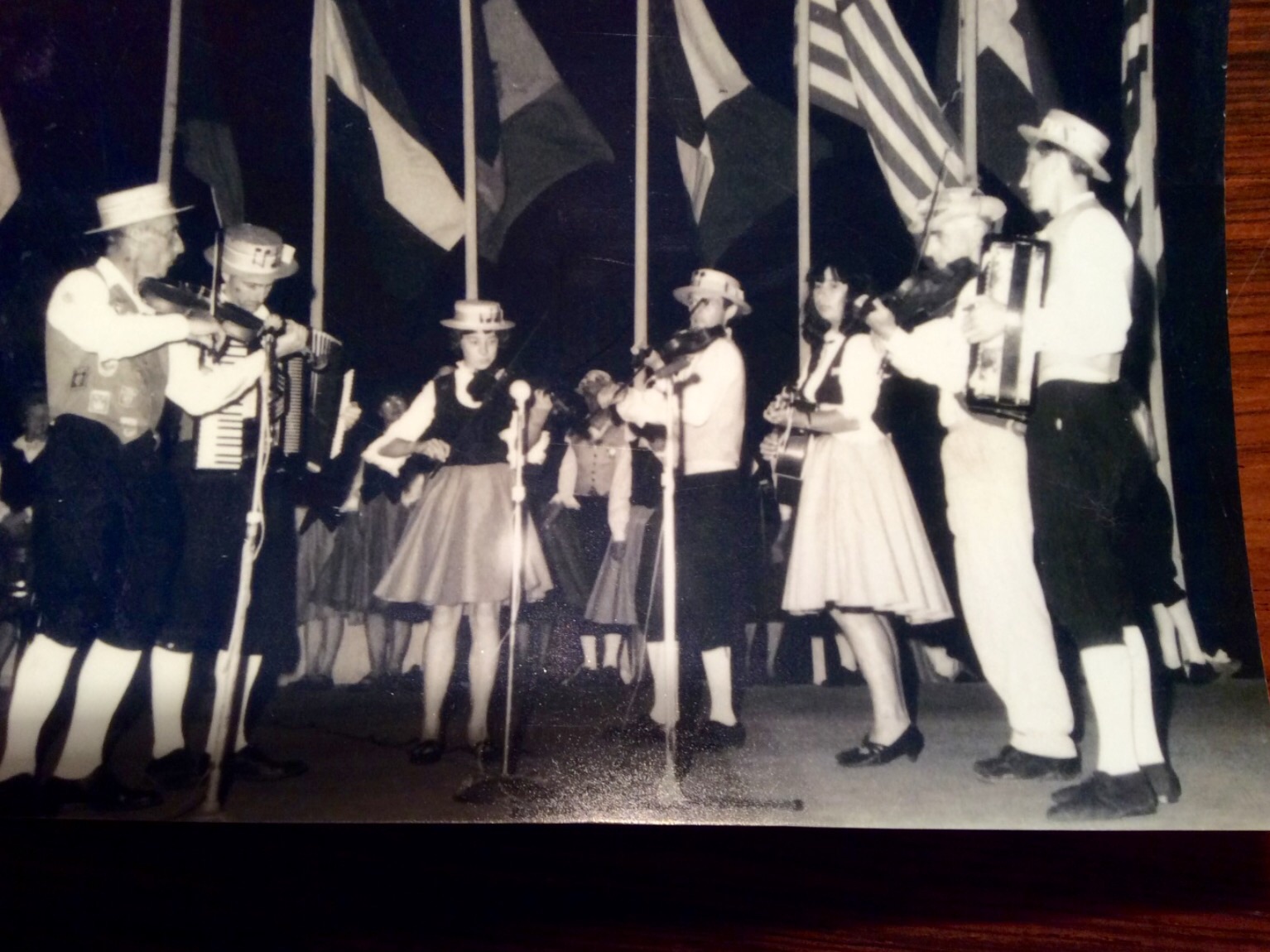
My sister Susan Elkin and I have mentioned before that at the heart of our musical background was our folk-fiddling father. In August 1966 he was invited to lead the band for a dance group to an international 10 day long festival in Greece. Mother danced and SuSan and I were included as musicians with our fiddles, guitar and recorder.

Our intrepid Father decided to make it a major family camping holiday and drive – to an unknown Greek island in the Ionian Sea. We could get by in French, but none of us had a word of Italian or Greek – unless you counted my three weeks of Ancient Greek in school the previous term. Holiday foreign travel was not the norm so it was an extraordinary and exciting adventure.
South east London/ Dover/Calais was straightforward and then our car was loaded onto the overnight sleeper to Milan. As the second hand clicked to 8.00 next morning the train glided to a stop. We admired this enormously – we were accustomed to British Rail. We drove that day across Italy to the Adriatic coast – Italy was way ahead of us in motorway building as well and we were enthralled by the fast roads with their immaculate and frequent service stations – stops were necessary because our wheels kept getting hot!
We set up our first camp on a seaside site near Rimini. Our parents had a gaily coloured frame tent, whilst we were in a grotty old ridge tent with no built in ground sheet. But it was all great fun and so different from our usual climate and surroundings. We made our progress down to Brindisi at the heel of Italy and without wanting to make us sound like the Von Trapp family, sometimes we would get our instruments and play outside in the balmy evenings amongst the olive trees.
From Brindisi we took the ferry over to Igoumenitsa on mainland Greece for the next leg of the journey. Topography demanded a route inland through the mountains and I doubt that this sparsely populated region saw many English vehicles and tourists. Our stop for lunch was interesting. We had no idea what the proprietor was telling us was available so with an enormous grin he ushered us all into the kitchen to see for ourselves. The final part of the journey was a chain ferry – the only vehicular access to Lefkas at the time – and thus we arrived at our destination.
The dance group, were, to me at least, quite elderly – although probably younger than I am now – and they were horrified on arrival to discover that the much anticipated accommodation was in fact a vast camp of old khaki army tents set up by the harbour into which the sewage was discharged – each one with a two bunk bedstead on bare earth. The temporary ablutions were not actually finished by the time the festival started and comprised open top wooden compartments. Several times we had to shoo away workmen who unashamedly sat on top of the female shower blocks. Each international group was assigned a local restaurant for meals and the offerings were not generally well received especially after my father told people with a perfectly straight face that they were donkey cutlets. A plea for egg and chips produced the chips – with a hard-boiled egg! Our family were better able to adapt since we were geared up for camping anyway and thought it all quite hilarious.
I recall very little of the actual performances but there were no disasters and all went as rehearsed. It was a big festival with dance and song teams from all over the world. Europe was well represented and I also remember an Israeli team and a clean-cut ever-smiling group of American Mormons from the Brigham Young University in Utah. Shows took place every evening on the temporary platform and there were lots of processions and parades. I suppose the ethos of these “Folklore Festivals” was to bring together post-war peoples through music and dance and to foster peace and goodwill. Did that happen? As a 13 year old it certainly made a great impression on me and I loved watching the various different nationalities performing.
It should not be too hard to spot us!

Greek folk


Our journey home was just as adventurous, but perhaps that should form another post!

Carole Collins-Biggs

Posted in Uncategorized | Tagged | 1 Comment