Carolling with the Carrolls and co

Credit to Howard Turtle

Credit to Howard Turtle – Susan Elfkin at work!

Credit Howard Turtle

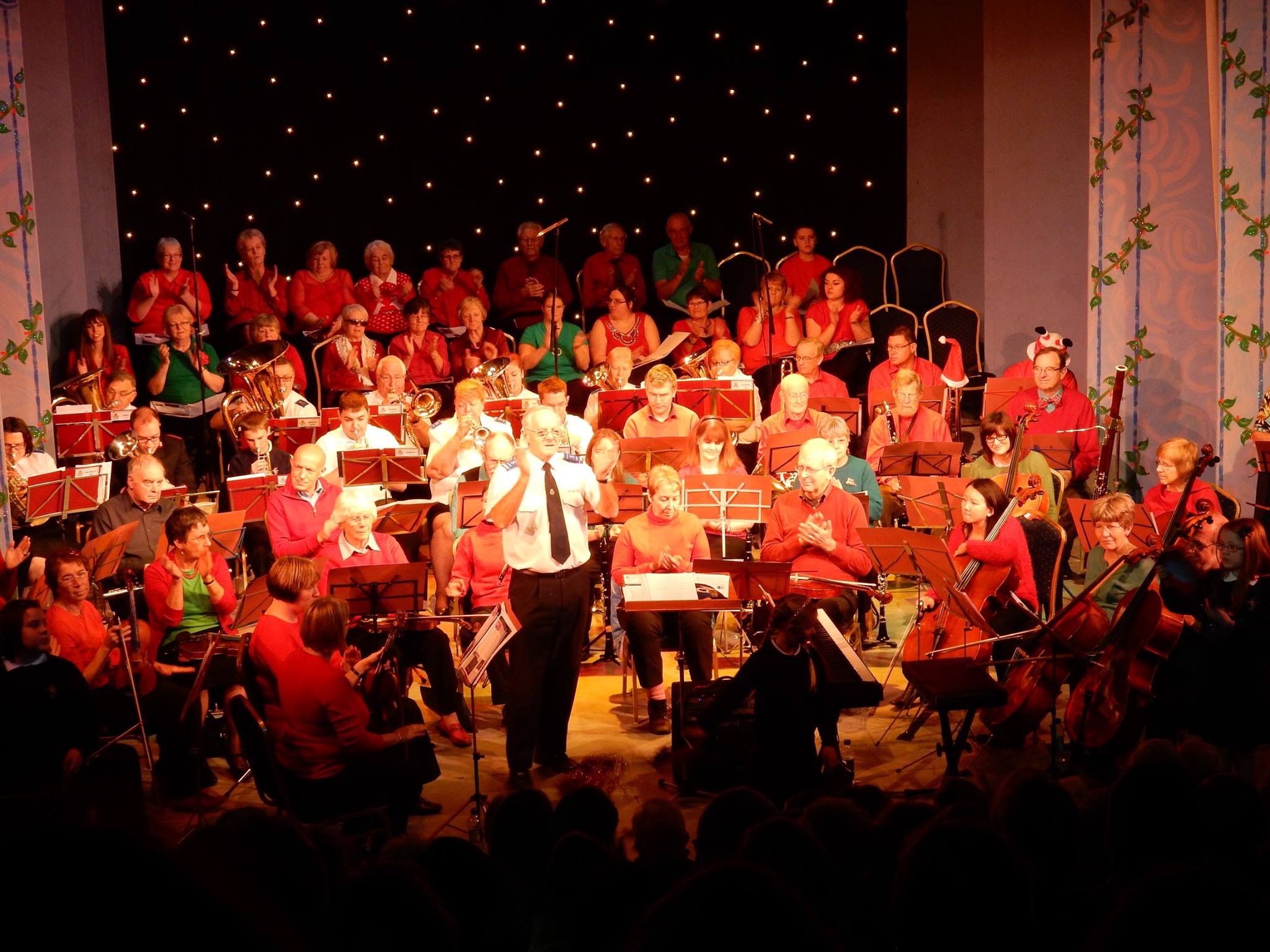
The whole ensemble…

It was with a mixture of incredulity, excitement and trepidation that I presented myself, dressed a bit like a Christmas elf, for Ashford Sinfonia’s Christmas Spectacular at the Tower Theatre in Folkestone on 21 December. I hadn’t played in a concert in a “proper” venue for over 40 years and I’d found much of the music very – ahem – challenging in rehearsal.

In the event it was an unexpectedly upbeat (pun very much intended) occasion with a full auditorium and a delightful family atmosphere. The orchestra was there as a guest of Hythe Salvation Army band, of which our conductor Wesley Carroll is a member and is conducted by his father Richard. Many Carrolls across three generations took part along with lots of other Salvation Army clans and we were all made to feel part of a joyful extended family – especially over a splendid buffet tea between the rehearsal and the concert.

The orchestra played three pieces and accompanied some audience carols. Of these the theme music to the 2004 film The Polar Express, by Alan Silvestri and Glen Ballard, arranged by Jerry Brubaker, was, from where I was sitting anyway, definitely the most demanding. Stringed instruments do not play comfortably in keys with half a dozen sharps or flats and in a very high register – and the piece requires all of that and more. We had, however, worked very hard at it both together on Monday evenings and in many manic practice sessions at home. On the night it seemed to come together surprisingly well, with some lovely work from the brass and woodwind sections, and was – although I never thought I’d say this – finally quite fun to play. It seemed to go down well with the audience too. Also enjoyable was A Most Wonderful Christmas, a collection of familiar melodies with lots of tempo and key changes. And as for the Christmas Medley, written and arranged by Wes, well it was such a joy to hear his fabulous piano continuo that it was quite hard to concentrate on one’s own part.

Wes’s outstanding pianistic ability also shone through in the semi-improvised accompaniments to the three Christmas songs warmly sung by Steve Hawkins and in music to accompany the collection taken by the Salvation Army – to be split between Folkestone and Hythe Operatic Society which runs the Tower Theatre and the Army’s own causes.

The Salvation Army band itself delighted us with Joy to the World as well as playing with us in A Most Wonderful Christmas and their choir gave a lot of strength to audience (and sometimes orchestra) singing.

Other highlights included children singing Away in a Manger, three young girls performing with tambourines, Richard Carroll’s expert compering, and thoughtful seasonal inputs from Salvation Army leaders.

All in all it was a highly successful evening and I hope very much that I can look forward to taking part in a similar Spectacular in eleven months’ time. I’ll keep practising my seventh position semi quavers in F sharp major meanwhile.

Susan Elkin


Posted in Uncategorized | Leave a comment

Reminder from the Secretary

Dear fellow musicians

Our first rehearsal of the New Year will be this Monday, Jan 5th, at Highworth.

And just to remind you as you plan your holidays, our concert dates for the next two terms are Sunday March 29th and Sunday July 19th.

See you on Monday,

Helen

Posted in News | Leave a comment

2014 in review

The WordPress.com stats helper monkeys prepared a 2014 annual report for this blog.

Here’s an excerpt:

A San Francisco cable car holds 60 people. This blog was viewed about 3,600 times in 2014. If it were a cable car, it would take about 60 trips to carry that many people.

Click here to see the complete report.

Posted in Uncategorized | Leave a comment

Something for the cello section…

http://www.classicfm.com/artists/2cellos/news/iron-maiden-trooper-rossini/

Posted in Uncategorized | 1 Comment

Folkestone and Hythe Orchestral Society

Another Christmas Concert…. FHOS Christmas Concert

Posted in Uncategorized | Tagged , | Leave a comment

The things our maestro has never told us – by his dad.

Richard Carroll

Susan asked me if I could write a piece about Wesley. She jokingly suggested that it could be along the lines of “Now get out there and practise or Father Christmas won’t bring you any presents” but I can’t. That certainly wasn’t our experience.

Wesley was born with a piano attached! My younger daughter, Wendy, is also a very good pianist and she was Wesley’s driving force. From the age of eight all he wanted was to be better than Wendy. But Wendy can play only with music so Wesley decided that to be better than Wendy he would need to learn to play “by ear”.

To achieve this he borrowed a copy of the first cornet tune book used by our band. This has only the melody line – no chords. Wesley sat and practised until he could play the tunes with harmony. And the rest, as they say is history.

However Wesley hasn’t sat one grade exam on the piano because he always said he wasn’t good enough. He passed all his grades on the euphonium. In fact that was what he studied at Goldsmiths College. Yet his piano playing has taken him into Europe, on a couple of tours to the USA and he has played in concert halls all over the UK including the Royal Albert Hall. He has also performed for Royalty. He was the MD for a professional singer, and has appeared on network TV, arranged the music and produced CDs.

PRACTICE? I’m sorry to say that practising was what he did almost 24/7. When he was at uni, he worked as a pianist for a dance school – everything from tap to ballet. On his first day the teacher decided that the warm up session would be “colours” starting off with red. “Wesley could we have some red music please? “What would you like me to play?” he asked. Teacher: “Oh just play something red.” So off he went. Then every few minutes she would call out “Now let’s be….” and would name a different colour and Wes had to just launch into blue, yellow and so on.

At the same time he was the resident pianist at a number of hotels in the area, including Eastwell Manor, Ashford International and others in Folkestone. Because of this he commuted to uni, but that meant he wouldn’t get home until 9.30pm. While he waited for his tea he would go into our back room and play the piano. Even on days when he hadn’t been to uni but had been playing at the dance school ALL DAY it was straight out to the piano.

Anne and I didn’t mind. In fact we loved it. Our home has always resounded with music. As well as Wes, my wife, two daughters and several grandchildren are all into music making and I don’t think I could live without it.

PS I hope this is ok – he will probably kill me – so it’s been nice knowing you.

Posted in News | Tagged , | Leave a comment

Yes, music really does change lives

Steph Batchelor

So, I’m sat in my kitchen on another Monday evening, desperately trying to keep myself awake after a day of school and a meeting after work, wondering just what it is that keeps me going to Ashford Sinfonia (almost) every week after all these years. I’m going to try and sum it up here.

After Uni, there were several years where my violin case was never opened. I was busy with work and having children. I reached a point where I’d convinced myself that I couldn’t even remember how to play. Eventually it was my old teacher, Layne Aviss, who forced me to try, She was conductor at the time, and I went back to make up the numbers for a concert. My hands shook so hard I could hardly hold my bow.

Anyway, I stuck it out, mainly because I’m stubborn and it got me out of the house. It was also partly because I’d forgotten how much fun playing in an orchestra is and because the group of players I had joined was so welcoming and friendly. No one made me feel as if my mistakes were the end of the world. The priority was making music, not being the Royal Philharmonic!

Skipping forward a couple of years and another baby, I found myself working at Highworth School, not initially as a teacher, but with the chance to start getting involved with the music at school. The confidence I had regained by playing regularly helped me convince the school that I was worth training as a teacher, amazingly, specialising in music. I honestly would never have believed it possible only a few years before.

So, Monday nights still come and I still keep playing. I do it because I have the best laugh of the week trying to watch our “genius” conductor without getting caught. And because I genuinely enjoy trying to fit all the semiquavers in the bar when the music has been ordered from some library without anyone thinking to look at the fiddle parts first.

Mostly I do it because this orchestra, which has given us all the chance to play when many of us wouldn’t, actually did change my life.

Posted in News | Tagged | 2 Comments

Winter Prom

PromClick to see the full poster Winter Prom Poster from Folkestone Choral Society

Posted in Uncategorized | Tagged , | Leave a comment

Bum Notes from the Brass section: In 1960s France remembering the fallen

Music is often associated with ceremony. ABandnd few ceremonies, especially national ones, are without music. Brass bands are a useful portable musical accessory for memorials in fields, town centres – wherever. Eastbourne Silver Band (ESB) had its share of call-outs to attend. Fecamp in France, for example, was memorable for many reasons.
Eastbourne was twinned with Fecamp, a town on the Normandy Coast. We were invited for a week at Fecamp’s expense to play at the liberation anniversaries of Fecamp, Dieppe, and other local villages and towns. Great. A week in France. Who could say no? Certainly not me.

The first Sunday, we were to play at a mass held to commemorate the liberation of Fecamp, held in a huge cathedral-sized church. We set up stands etc. in the choir, the area between the altar rails and the steps of the high altar. Whispered instructions told us to behave – no breathing down the instruments, rattling, fidgeting. “This is serious!”. We got the message. The mass continued now in French, now in Latin, now hymns accompanied by the organ, for well over an hour. A man from the committee had been detailed to show us when to stand and sit without a sound, and time passed slowly. The urge to fidget became ever stronger.

Finally, our turn. We were to play at the most solemn moment of the mass, when the congregation came forward to take Communion. The Band Master had chosen a theme and variations on the popular hymn, Abide with Me. Nothing to tax us at all, well within range and capabilities. Except the whispers insisted “No breathing down the instruments, no tune up, no warm up – just straight in at the drop of the baton!”

Perhaps it was the place, the occasion, but I can still run the little memory clip of those moments. Every instrument of the band spoke at once: perfectly in tune, time, dynamics, balance – except mine. Nothing came out. I was about to catch up on the second or third note when I heard the soft echo return from the stone walls. Magical? Holy? Spiritual? There is no sound that can better an English brass band doing justice to a solemn hymn. The sound of the band rose up gently filling the space with an amazing acoustic, I was mesmerised. I dare not join in for fear of disturbing the balance. It not only made my heart sing but seemed to have the same effect on the congregation – which was many hundred strong in this huge church.

Tuesday should have been our day off, but the mayor of a neighbouring district had seen the coverage in the newspapers, and contacted the organisers. ”We have a war cemetery here with a British section. Would the band like to pay their respects? We’ll lay on lunch”.

Then the trouble started. Band members were both male and female, but only the serving men had been trained to do a slow march. We youngsters and the ladies needed lessons. The Navy guys said do it like this. The RAF boys jeered. And the army broke up into separate groups by regiment each insisting that their slow march was the authentic one. Words were said and voices raised, but no agreement reached. In the end the order was “Do it as you were trained. And for the others choose any style but keep in time”.

The coach came. We lunched – with wine – and were deposited at the cemetery gates where we lined up. The (strange) order rang out “By the left, slow, march”. And the commotion began. No, not in the band but among the bystanders: journalist, photographers, committee members, the curious and a dog. “What kind of march is this? You are insulting your own brave countrymen!”. It probably did look a shambles – four or five different steps made with precision and others lackadaisical. The eldest, our octogenarian, couldn’t hold his balance properly much to his growing annoyance. The air around him became ripe. Good job the French didn’t understand him or there could have been an incident. It was fortunate that we had a journalist from the Eastbourne Gazette who was able to give an explanation.

The mood of the band became sombre as we marched through the lines of tombstones of the fallen. Men the same age as the younger of us – dead at 20, 19, even 18. Serious food for thought, and time to explain the age dynamics of the band. The year of this trip was 1962 or 3 and I was 22 or 23 years old. As the ages of the bandsmen ranged up to 80+, most of those who were over 40 had served in either WWI or WWII – totally within living memory of everyone present. Although the names on the stones were not known to us, they reminded us of comrades, fathers, brothers etc. who had died. We later learned that our journalist had landed on the Marlborough harbour on D day + 3. “There but for the Grace of God go I”. We did not taunt him again.

We arrived at the British section and the memorial cross, fell out and re-formed ready for our short ceremony. The principal member of the saluting party was a member of the band. “How come he missed the march?” we whispered (in slight revolt). The answer was not long coming back. A sergeant major in the First World War, he was too old to serve in the second. But his son did serve – and was killed a short time after the allies had broken out from the beach and into France. He was buried in an allied cemetery a hundred or so miles inland. This would be the only opportunity for the father to salute his son and the others who had fallen so near to his boy. Stunned, we came to attention.

There was one more shock. After the Last Post, exhortation, 2 minute silence and reveille, we formed up and quick marched out of the cemetery to Colonel Bogey. In the coach we challenged this decision. “Can it right to thumb our noses in the graveyard?”. We all knew the vulgar “alternative” words. The answer was: “The ceremony is for the fallen. When we leave, we play for those who are in uniform today . What better than a quick march down to the pub?”. “Yeah. OK we get that” – but the French don’t have pubs so we just had to improvise.

On the final day, we were told that we would be the first English band to march through Dieppe since the liberation 20 years before. With this boost to our ego, we boarded the coach without noticing that it was only 10 in the morning and we were not due on parade (with 4 or 5 other bands) in the main square of Dieppe until 3 o’clock.

We disgorged from the coach some way out of town, fell in and marched off down a side street, playing our first march of the day. We were ordered to a halt – nowhere. In the middle of a side road with houses on both sides, and no distinguishing marks. We played the French and British national anthems, and set off again. After 5 or minutes or so the same thing happened again. This continued for half-an-hour or so. Muttering in the ranks could no longer be ignored. “We are honouring the memory of those brave men and women of the French resistance movement who had died at the hands of the Germans – sometimes under the most unspeakable circumstances”. All our resistance faded. We carried on for a further hour and a half. The lunch and wine made up for it.

There was a last sting in the tail. Leaving the restaurant we formed up and marched to the square and main parade. No longer on side roads, we were on main streets through the shopping area and normal Saturday traffic. We hugged the kerb. This route was lined with people, three or four deep. Many were out shopping, but a significant number started to take notice of the band and we struck up a march to keep us going. But our tune was not what that they wanted us to play. Recognising that we were English, they sang back to us “It’s a long way to Tipperary”. We didn’t have the music or we would have led them. A cornet player, I was on the outside column next to the kerb, and was startled as I felt my uniform being pulled. I turned and stared into the eyes of an elderly lady who stared back at me through her tears and stuttered “Les Anglais – Merci, Merci!”. What had she lived through and endured? Who had she lost?

Whether it was this incident or an accumulation of the week, but I don’t remember much of this last parade. (It wasn’t the wine as I had been put on strict rations following the incident after lunch at the Château). I returned home quite changed.

David Worsley
Horn
Posted in Uncategorized | Tagged , , | Leave a comment

Music you dislike but can’t resist?

During one of the Proms this year I turned on the radio (well started it on an app on my phone, to be precise) and it was the early stages of Ravel’s Bolero. This was the piece that Torvill and Dean won their Olympic skating gold with. I was immediately drawn into the music with its distinctive repeating pattern on the snare drum and the main melody which gets dressed up in many different ways. Over time the music builds and builds. Then there are the blaring trombones, swoops late on followed shortly after by what sounds like everything coming crashing down in conclusion – as if the dancers simply can’t continue any longer. It has a sort of mesmerising effect that meant I had to listen right to the end. The thing is, though, that I don’t like Ravel’s Bolero. And as I listened to it I kept confirming to myself that I didn’t like the piece. Yet I couldn’t stop listening to it. So, I wonder, does anyone else have a piece of music that they don’t really like but can’t help listening to when they hear it? And while we are at, what about the tunes that get stuck in your head and you can’t get them out? I think the worst one of these for me is second section of the Birdie Song…..what about you? Feel free to comment below. Arghhh, the middle section of the Birdie song is playing in my head… Wes Carroll

Posted in News | Tagged , | Leave a comment